
1990s was THE decade to be in a Romanian rock band and I survived to tell the story.
Following the swift execution of dictator Ceausescu and the collapse of the Communist regime in December 1989, a profound sense of exhilaration permeated every corner of Romanian society, touching upon the economy, social interactions, and the arts—including rock music.
Being a rock musician in the 1980s held immense significance, serving as a symbol of the coveted liberty under the communist regime. With that liberty now attained, bands like Survolaj emerged, hailing from the city of Timisoara, where the Revolution began in mid-December 1989. Formed around 1988, Survolaj had already gained local recognition and even participated in the most significant rock festival permitted under the communist rule, the Buzau Rock Fest. During the Revolution, members of the band took to the streets, risking their lives in protest.
In January 1990, the band made a notable appearance on the nation’s sole television station, TVR. The year 1990 passed swiftly amidst major political upheavals gripping the nation, without the birth of any significant rock festivals. However, in early 1991, Bogdan Nicolescu, a young radio DJ from Bucharest, embarked on a journey to Timisoara to persuade Survolaj to perform in the capital. Despite the lack of suitable venues (as nothing had been specifically designed for music during the communist era), Nicolescu succeeded in booking a community center in Bucharest and arranging a sound team. He also secured the attendance of radio personality Florian Pittis. The concert, Survolaj’s inaugural performance in the country’s capital, sold out swiftly and immediately ascended to legendary status, propelling the band to cult status.
Frontman Daniel Silvian Petre astonished audiences with his climactic, soaring vocals, reminiscent of a diva, a style previously unheard of in Romanian rock and rarely replicated since (check minutes 35 to 40). Picture Ian Gillan in “Child in Time,” but with an even higher pitch. In addition to his vocal prowess, Petre revealed a poetic sensibility, incorporating folkish blockflute parts and lyrics from esteemed Romanian poets such as Tudor Arghezi (“Hora de baieti”), Lucian Blaga (“Cintareti bolnavi”), and Al. Macedonski (“Cintecul ploaiei”). This multifaceted approach to music paved the way for Petre’s later career as a published poet, which began in 1996.
The charismatic guitarist Zsolt Szabo solidified his reputation as a prodigy of slide and wah-wah techniques, captivating audiences with a stunning bow and guitar performance reminiscent of Jimmy Page as he opened the concert. The chemistry between drummer Levente ‘Levi’ Molnar and bassist Catalin Teodoreanu, rooted in their shared influences from mentors like Black Sabbath, Cactus, or Cream, was palpable. Their adeptness at jamming and seamlessly integrating the guitar into a powerful, flawless engine, as demonstrated in the final minutes of the concert, foreshadowed the promising days ahead for the band.
Survolaj went on to record just one album in this lineup, Survolaj 1, in 1992. I was in the studio with the band and a few close friends during the recording session in March 1992.
That album, released on vinyl only, is a precious collector item nowadays. My name is mentioned in the special thanks section.
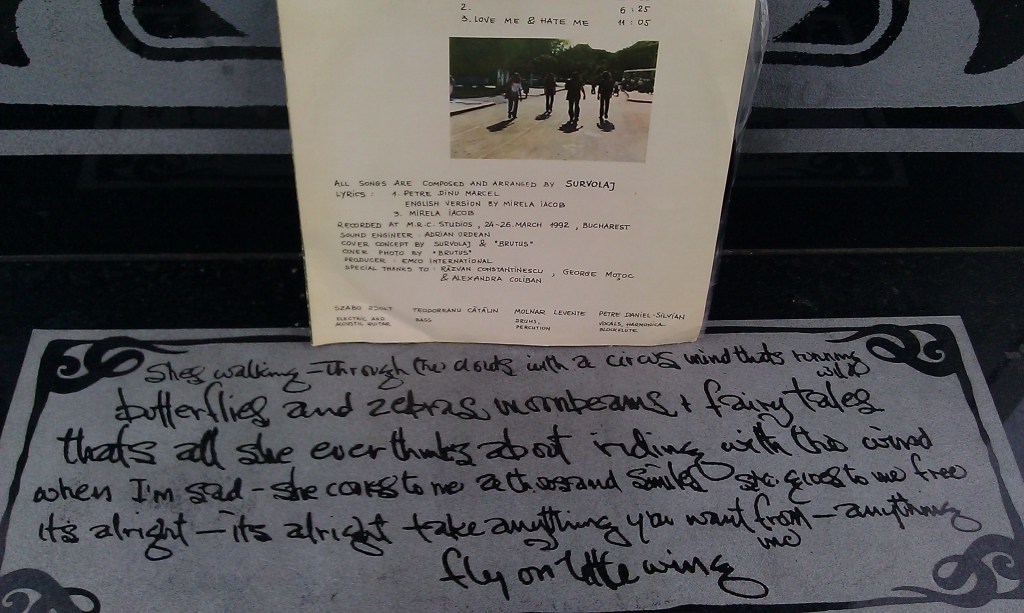
It is not available on streaming but can be found on YouTube.
MORE ROMANIAN PROGRESSIVE from the 1990s Other hidden treasures of Romanian progressive rock of the 1990s include
- Talitha Qumi (one album published, listen here),
- D’aia (never published; listen here their studio records) and
- BMG (an album published, listen it here).




 George Motoc
[…] for too many years: Daniel Bustan (he works in animation in Montreal), Ann Corn and Kiru (of the cult Romanian prog band of the 1990, D’aia) Roger Waters Roger Waters spent his September birthday launching his THE WALL 2014 movie in […]
[…] concertau pentru a treia oara in Bucuresti, dupa debutul din aprilie 1991 (vezi aici integral concertul organizat de Bogdan Teodorescu), si aparitia halucinanta din iunie 1991 la Cociock (pe […]